Where Days in Autism Turn from Good to Bad

IMG_1276 2.JPG

Most days are good when they start good and don’t deviate from that.

Some days are bad: rarely do they begin that way, but once wrecked, they are hard to un-wreck.

Our days are trains on tracks. They’re not dune buggies on sand. They’re not cars. They’re not bikes. They’re solid, sequential, massive, linear locomotives. They’re not nimble.

The good days on the Life Autistic are a matter of keeping the train on the tracks.

We generally derive a certain kind of functional health, anxiety reduction, and mental acuity from predictable routine, limited variation, actively reducing disorder through discipline, and healthy personal and emotional inputs.

“Ew, gross…routine, discipline, you’re SO BORING, Hunter!”

Shut up.

Just because you work to execute a plan doesn’t mean it’s boring. Try commanding a space mission. It’s incredibly regimented, but it’s far from boring. It’s just executing on one thing at a time.

But that’s where things can differ.

Moon missions, battle plans, football plays, whatever: there’s a procedure for when things go wrong. I can’t always have that procedure.

The bad days on the Life Autistic are when that train falls off the tracks.

Your car can veer off the road and climb back on. A dune buggy on sand needs only find the general path forward. But once a train is off rails, it’s going to stay off for a while.

And that’s what people struggle to understand with our autistic experiences.

Sure, we’d love to “shake it off” and keep moving and forget. But that kind of ‘resilient amnesia’ doesn’t always work. We’re reacting to new variables, trying to plan on the fly to compensate, to focus — it’s a crusher at times.

There are no magic tricks that work. Gratefulness, positivity, mind hacks — they’re often too emotionally inauthentic to add to our already difficult stance of maintaining some level of emotional and social masking anyway!

The worst bullets are the unhealthy emotional and relational inputs. We’re not robots. We have deep feelings. We don’t take kindly to abuse. I’m a grown man and I still get bullied by malicious, unrepentant people. It is hard to navigate these social roads, and it’s only harder when someone rams their spiteful vehicle into mine.

Despite the days going bad, there are things that make the next days better.

The next day.

I am fortunate in that I’m not as affected by longer term depression — other autistic people are, and this magnifies the challenge. That is an entirely different battle.

But for mine, each day is a new routine to be worked through and lived without derailing. More of those are good.

For our experiences, we benefit from how you help mitigate chaos, keep some order, and be kind enough in a way that will keep our train chugging along on the rails.

 

I Delivered my First Talk on Autism and Lived to Tell About It

IMG_0220.jpg

It’s the final day of Autism Acceptance & Appreciation Month, so I appreciate that I was able to speak about autism at work this week. While it was a welcome break from my normal talks about data visualization and analysis, it was definitely not a break.

But was it ever worthwhile and timely.

There’s a world of difference between venues offering perspective on autism vs. autistic perspectives. I’m grateful mine was the latter.

So what happened, and what went well?

For starters, the event organizer was a gift, and she helped hammer out the topics and themes well beforehand. I can handle surprises, but she made sure this talk would cater to not just the audience’s needs, but a comfortable style of exchange.

I also had the questions beforehand, where I could mull over the answers and think about where I could thoughtfully inform on autistic misconceptions, being an ally, autism at work, and supporting autistic people growing up, along with neurotypical parents of neurodivergent children.

There’s one caveat.

For every talk, anytime someone makes the mistake of giving me a platform, I’m very quick to outline a key point: I speak from an autistic perspective, but I’m uniquely autistic and my experience isn’t going to be 100% representative of all autistic people.

It seems like that would detract from the message, but it was good to reinforce that autistic people are all unique, and that our voices are stronger through diversity. I’m not an “autism expert,” but I am an expert in my “autistic experience” — that helped.

There were good questions and real needs.

While I can rail on the struggles, there are people who genuinely want to support us, irrespective of disclosures. It was good to explain the practical steps on how. And then the parents, with whom I wish I could empathize more directly, who want to better support their uniquely autistic children — there’s never been a better time to grow up autistic than now. Knowledge is power, and we have so much of both now.

This wasn’t without mishaps.

I made the mistake of getting fancy with a self-description on incongruous juxtapositions, slipping in ‘Shakespeare-quoting history-majoring data visualization designer.’

Oops.

The follow up question: “Oh, what’s your favorite Shakespeare quote?”

That’s the lesson, y’all — never mention what you can’t prove. I rattled off the first one that came to mind and stultified the minds of my enduring audience with half-baked literary criticism on the fly. My apologies.

(But not for using ‘stultifying’ – it was nice using big words freely in a talk for once!)

It went well, and it did well for the autistic acceptance and appreciation cause.

So: if you’re an employer, manager, ally, advocate at work — autism is the next and long-overdue step on your inclusion, diversity, and accessibility effort.

Bring in authentically autistic voices. We do want to share. And we can help.

Even if we have to come up with a Shakespeare quote on the fly 🙂

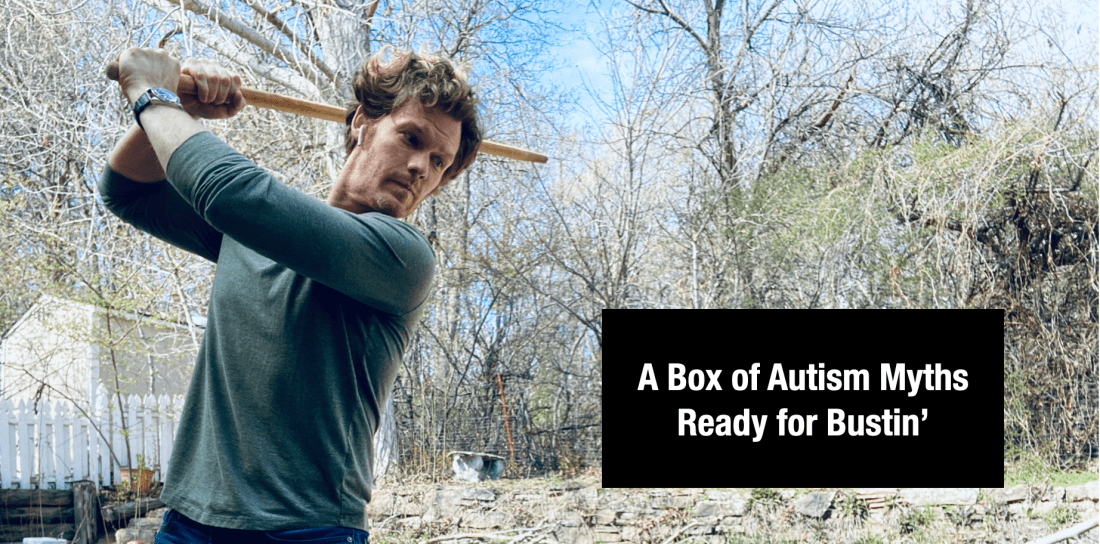
Let’s Go Bust Myths About Autism!

Screen Shot 2020-04-24 at 10.09.25 AM.png

THWACK!

Let’s go bust a few myths about autism today.

Myth: Autistic people don’t understand sarcasm or idioms. While I can probably dish sarcasm better than I can take it, that doesn’t mean we’re incapable of learning to process communication cues and context that would clue us in on idiomatic and sarcastic usage.

Myth: Autistic people are incapable of empathy. That’s flat out untrue, but I’ll admit that this myth didn’t come from the nothing. We might view some emotional circumstances far more concretely and detach ourselves from reacting as most would, but that’s not to say we can’t empathize at all.

Myth: Autistic people are savants with some kind of super ability. Some are! But that’s not generally the norm. It’s not like I can’t fold a shirt the right way yet can bust out Beethoven on piano with my eyes closed. No, I just can’t fold shirts.

Myth: You can’t be autistic if you’re independent. This is why I’m not a fan of functioning labels. Some autistic people have greater needs and dependence. Some don’t. And some phase between both at different times in life.

Myth: Girls and women can’t get autism. That…no. Just no. One of my own key discoveries in this journey was with how imbalanced the diagnostic story is with autism, skewing more male than it should. I’ve been more woke to autistic women and their voice, and you should be too.

Myth: You can cure autism. *spitting out bleach*  Uh, what’s there to cure?

Myth: An autism diagnosis is a death sentence for your child. It’s not. You’re more supported than ever. It might not be easy, but you’ll make a world of difference inappreciating them for their autism, not despite it.

Myth: Autistic people can’t make many friends or have meaningful relationships. I might not have many friend-friends, but I have a couple very good ones. I’m also married with three kids. I’m extremely fortunate. It has been a journey for us all, but at least that’s a journey that can be made.

Myth: People use autism as an excuse to be jerks. People think this. This is wrong. Please stop. When I’m a jerk, I’m a JERK because I’m a jerk, not because I’m autistic.

Myth: It’s difficult to hold a normal conversation with someone autistic (h/t Katie Wagner). Depends on your definition of ‘normal!’ If we’re talking ‘small talk,’ or otherwise run-of-the-mill, banally anodyne conversational fare, that’s painful for us too. We’re not always the most chatty, but sometimes we’re overly chatty – by no means are we going out of our way to make it difficult.

Myth: Autistic people are all introverted and can’t socialize. Whoa, yep, this here is a myth. There was one event where people claimed they missed me because of my flair and energy or something. Yeah, weird, right? It’s exhausting, but it’s by no means a natural inability. Some of us do enough to get by.

Any other myths we need to smash? Comment and lemme know.