This Season’s Autistic Positivity Tools

I’m not your typical “positivity guru.”

I don’t have time to measure whether a glass is half full or empty. I don’t think of who has it worse, because I can think of who has it better. And I don’t count blessings, because their quantity has nothing to do with their quality.

So when I share some of my autistic positives, they’re not gimmicks. They’re not tricks in the sense of generating wealth by pulling a coin out of a child’s ear.

When I talk about positive outlooks and tools in autism, I’m referring to actual, replicable, tangible things that help my autistic experience.

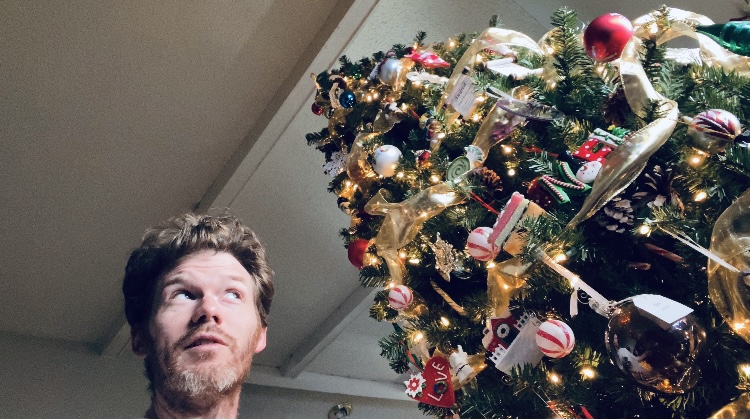
See that gigantic tree? It’s not just a tree. It’s a tool. I enjoy this tree.

So every morning, I make a point to plug it in first thing. I’m the last to see it lit each night and the first to see it lit each morning. Why? Because I love the way it looks, and I intentionally put time into making it visible in my memory and my routine.

So that’s one tool: a big good thing in the routine. And it’s sorely needed this season!

This holiday has brought to mind a few more. I’ll share some:

Say ‘Yes’ and complain later. I can way more often say no to a lot of things. I’m practically Dr. No, like my father before me. But when it’s coming time for Christmas events with my kids, I’m just lightly brushing it with logistical though and saying ‘Yes.’ I’m not overthinking. If it’s a short event, yes. If it’s cute, yes. If it’ll make the kids smile, yes. So even though I froze my nose off at an outdoor tree lighting ceremony, I captured a small pocket of good memories and deferred the far fewer complaints afterward. Sometimes you have to know your map and where you can make the shortcuts.

Embrace what you love amidst what you don’t. I had to endure a bit of an awkward, uncomfortable change in one of my routines, where there were going to be some different events, seating arrangements, and transportation detours for an event. But despite all that, I didn’t have to drive. So I applied that tool with force, hugging that small and lovely fact with both my arms: I don’t have to drive. I DO NOT HAVE TO DRIVE! Sure, it might be insignificant and not enough to make up for the rest of the odd arrangement, but, y’all — I didn’t have to drive. And I loved it, and I hyperfocused to embrace it.

Tell yourself how funny the story will be. One of the reasons people find me funny — I’m an advanced “coper” with many faults, slights, wrongs, and tragic turns that age well into comedy. I’m often more sad than I ever let on to people. I’ve spent more of my life frowning inwardly and laughing outwardly. But then I think, “Gee, if things weren’t so bad, where would I get my jokes from?” Other than my daughter pooping through her tights and leading me through a calamitous episode doing haphazard laundering with a soap foam dispenser in a public restroom, I don’t have a recent story to recount. I just remember that in the moment, despite how sharp the awkward conversations and autistic abrasions may feel, if I can just live to tell the tale and practice my comedic timing, then at least I can tell a few good yarns at the next uncomfortable party I endure.

I’d be interested in some of your tools too! To learn more about autism from an autistic person’s perspective, follow & subscribe to The Life Autistic here and on YouTube — or follow the more whimsical, spontaneous, and amusing content on Twitter / Instagram.

Oh, if you’re still here, would you consider subscribing to my YouTube channel? I’m well-taken care of, so I don’t need any “buy me a coffee” donations — but you’d make my day with a subscription. It’s far less expensive! Thanks ^_^

A Strong Back: Lessons in Autistic Resilience

I guess this is what passes for self-care.

When I need to “be in the thick of it,” but also catch a break, I’ll find some space and lie down in the prone position and rest. And then comes my scamp tot Zo, who insists I “stay right there.” I brace myself.

She then begins to walk up my calves (which, ouch), then tiptoes delicately from my lower back, spine, with her stout little feet planting square betwtixt my shoulders. She stops, pauses, kneels. I wince. She then springs into a jump from atop my shoulders clear over my head.

Whew. Glad that’s ov—

“Again, again!” she pleads. And on I lie for another calf-back-shoulder-jump walk. I like to think it’s some sort of walking massage, but with a tiny person who occasionally jumps on your head when it’s done.

After a spell of injuring my lower back and being laid up multiple times, I’ve since built back my back, forging weakness into strength, soft dough into cast iron. As a kinda-tall dude and a dad of three, I’ve had to shape up and ensure I can withstand backbreaking activities. Like whatever this thing is that Zo does.

I’ve had to build a stronger ‘back’ in my autistic experience as well.

Thanksgiving week is always tough, but this round taxed both my literal back (with perpetual kid-handling, toting, baby-propping, etc) and my figurative back.

What do I mean by that?

Autistic resilience is withstanding things. With some major back-to-back episodes in my home life, I ended up doing a lot less but bearing more: late-breaking changes to plan, unexpected purchases, a wild Thanksgiving day, and then some. I only wished to be called to action to focus and fix things, but instead, I had to endure a lot of uncontrollable variables with a smile. In autism, active calamity feels more purposeful; passive calamity is painful.

Autistic resilience is isometric. If you’re into fitness, words, or both: you know what I’m talking about. In both exercise and autism, I prefer plyometrics: where I can jump or otherwise create momentum. But isometric workouts, like wall sits, planks, or (my grudging new favorite) hollow body holds, require a painful amount of positional endurance. It looks easy, but it isn’t. This has a distinct autistic parallel, to where things like “sitting and small talking without being able to escape” are the psychological equivalents of a 2 minute wall sit. Ouch.

Autistic resilience is a hidden strength. When it comes to “prominent muscle” – one’s back isn’t the first thing to pop out of a shirt or in one’s physique. It’s not something you can often show off ahead of time. The metal is there, but you only see it in the effort spent. I feel that way a lot, where going through events and holidays with a smile, shreds of congeniality, and maybe a pinch of small talk — that can be extraordinarily taxing. It may not look like I have the “guns” for such, but I’ve had to work up the back for it — it’s there when it counts.

Maybe someday I’ll write about the autistic equivalent of deadlifting! To learn more about autism from an autistic person’s perspective, follow & subscribe to The Life Autistic here and on YouTube — or follow the more whimsical, spontaneous, and amusing content on Twitter / Instagram.

Oh, if you’re still here, would you consider subscribing to my YouTube channel? I write because it’s my one talent, but apparently The Life Autistic videos are pretty entertaining as well, and I think you’ll enjoy them. Thanks so much!

The Rarest, Best Thing Autistic People Want to Say

Sometimes we talk too much. Sometimes too little. Sometimes not at all.

But for those of us verbose and wordy autistic people, I think I found it. The one phrase that—when we can say it honestly, truly—makes a world of difference.

The other day, I had to employ a self-hack, something I call “My Own Best Friend.” It’s like when you talk to and think of yourself as your own worst enemy, but in reverse. Weird, huh? It works, and sometimes it’s a revelation. Sad that it often has to come to that, but whatever.

So in triaging how a recurring scenario has been affecting me negatively and compounding in its specific impact on “autistic me,” I walked through a couple of less-than-helpful admissions before arriving at the one that unlocked it for me.

“You’re right.” This one is a defeat. It’s what you say as a concession to someone browbeating or otherwise twisting your arm into a truth — irrespective of whether it’s not true, it’s like you’re the horse being led to water, then dunked straight in. It’s just…not the best. If someone gives you this answer, then you’ve dropped the proverbial ball and need to do better.

That’s right.” This one is better, but not there yet. One of my favorite Chris Voss tactics — where you get someone to acknowledge the larger truth-behind-the-truth, aligning on a key, deep-rooted motivation for what you’re doing. It’s clever, but it still falls a bit short of where we autistic people yearn to express.

So here’s the phrase:

“I know, right?”

Yes.

That’s the phrase.

“Come on, H2, people say that all the time.”

I’m sure people do.

But among autistic people saying this about uniquely autistic things? That’s not common. That’s rare.

It’s rare that people can articulate and echo back why things affect us the way they do. The unique stressors. The specific pain points. The otherwise unexplainable emotional toll of otherwise inoffensive situational toll bridges.

To be able to spin it back, validate, elucidate, and distill in a way that makes not just sense universally, but specifically for us: getting an honest, true “I know, right?” is liberating.

Bizarrely, people have found my content “relatable” for this reason — and I had no idea anything I felt, said, did, or expressed, was relatable! But apparently that is so, and very so to a very select few.

The few who rarely get to say and mean “I know, right?”

In the neurodivergent experience, “relatability” is hard to come by. But when we find it and lock in, it’s a world-changer: in those moments we are less alone. To learn more about autism from an autistic person’s perspective, follow & subscribe to The Life Autistic here and on YouTube — or follow the more whimsical, spontaneous, and amusing content on Twitter / Instagram.

Hey, if you’re still here, would you consider subscribing to my YouTube channel? It’s quickly becoming one of my more impactful vehicles for autism advocacy. It’s unique, fun, and it’s going a little way to help people better understand the ‘different normal’ of autism. Thanks so much!