The Life Autistic: Why Handwriting Sucks

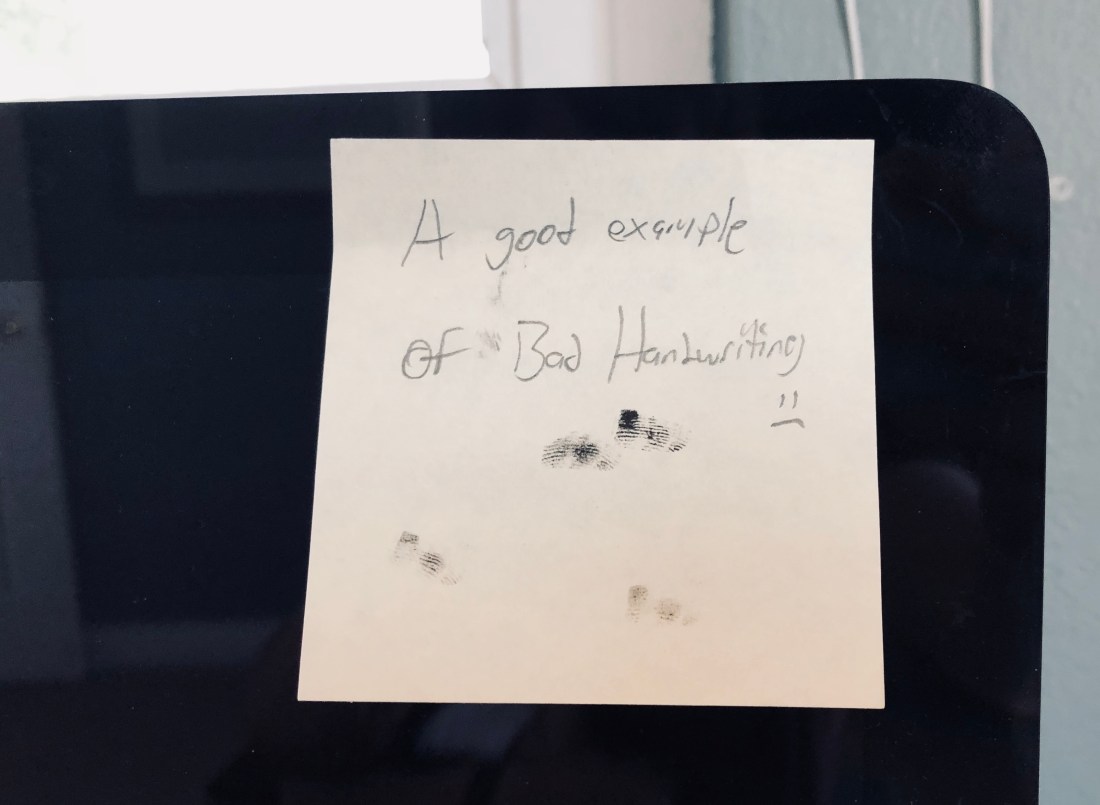
IMG_6384.JPGI remember taking notes for an absent classmate back in 4th grade. That was a mistake.

While I thought I was doing her a favor, it turns out that she spent more time decoding my hieroglyphic scrawl, consulting forensic experts, and soliciting translation assistance for my poorly handwritten notation.

She probably failed the test and never spoke to me again. Typical.

My handwriting sucks. It just does.

I used to think that it was due to an early bait-and-switch in my second preschool, where, as the only leftie, I was forced to comply with the “right” way to write along with the class.

But no, while that may be part of it, it turns out that it’s common for us high-functioning autistic folks! It’s like there’s something that gets lost in transcription there.

“So what, H2? It’s 2018. Get over it. Nobody uses pen and paper anymore.”

You’re right about one thing: it’s 2018, not 3018.

Kids like me still write in school. Visit an elementary class sometime and lemme know how many of them text and type before learning to write. We’re getting there, but we’re not there yet.

You try being one of the sharper kids in class who could be out trying to learn about socializing during recess, but no, he’s stuck miring through a penmanship worksheet. It’s a struggle at a young age. And get this:

Handwriting is a struggle for us autistics at any age. 

And sometimes it does matter.

I don’t like putting down more than just my signature when writing in birthday cards.

I’m not the one you can count on to jot something down.

And my wife would appreciate a love letter once in a while, but I’m embarrassed and taxed in writing her one that doesn’t look like it came from a 1st-grader.

So yeah, if we insist on texting or emailing instead of writing: trust us, it’s for everyone’s good.

The Life Autistic: OMG LOUD NOISES – What Now?

Screen Shot 2018-07-05 at 8.24.09 AM.pngFireworks. Who wouldn’t love them?

Well, lemme tell ya . . .

We spent the July 4th with some of our friends whose son also happens to be on the autism spectrum. He’s got a bit of a different symptom set than I do.

For example, he’s way more coordinated and active than I was as a kid, and while he’s not as hyperverbal, he has an almost uncanny talent for sound mimicry.

He’s been doing exceptionally well with therapy, support, all that good stuff. So, I was surprised and not surprised to see him walk out with these awesome noise-cancelling headphones.

“Yep,” said his dad, “If he’s bothered by a loud noise, he just grabs the headphones and deals with it.”

But here’s what’s interesting:

Loud noises are different strokes for different autistic folks.


It’d make sense for us autistics to be noise-sensitive, but apparently it’s more of an all-or-nothing deal.

Me? I now enjoy loud noises.

Weird, huh? I might not be for commotion or a gaggle of people in my kitchen, but I’m drawn to BOOMING sound.

Fast-forwarding to the fireworks show, there was my friend’s son, jumping up and down, hands to headphones, getting a KICK out of the show, the lights, and the (manageable) noise. It was amazing to see him manage his senses to better enjoy the sensory load.

But I’m all about that feeling – the resonating waves kicking into my sternum, rattling my bones, heaving me back with sonic oomph. 

The firework sound doesn’t bother, move, or otherwise delight me. But the splintering crack whipping through the air and cascading down to bump me back into my chair? Yeah, man, bring me more of that.

Just another quirk of the Life Autistic: even the things that’d seem unmanageable can be enjoyable. 

The Life Autistic: How Could You Forget How to Ride a Bike?

Screen Shot 2018-06-19 at 9.56.54 AM.png

You know that phrase, “It’s like riding a bike – you never forget how?” I’m here to tell you that’s bogus. Bunk.

have forgotten how to ride a bike.

I may be exaggerating, but that there’s not a lot of membership in the Autistic Athletics Association. The spectrum life is about dealing with physical gracelessness and disinclination toward the social aspects of formal sports, athletics, etc.

Exceptional coordination and athleticism is uncommon, but even common coordination can be a challenge for us autists.

I learned to ride a compact, green Huffy bike through the neighborhood of Burke, Virginia. While I was six of seven, I can’t say I was embarrassed about that late start. I was an official biker.

Fast forward to Iceland, that winter, where my parents bought me a new Roadmaster for the “summer” rides we’d take. And by the time that season rolled around, I’d lost it.

I’d literally — in the space of a season — forgotten how to ride a bike. 

I was almost a decade away from discovering just how different I was, but this was embarrassing. Who out there just up and loses their ability to ride a bike?

People like me.

People who fight for every fiber of muscle memory. People who put in work to get to only passable levels of coordination. People who aren’t naturals at this.

I was a whopping eight years old. Young. Stupid. Stubborn. 

Stubborn enough to get back on the bike and try again. And fall. And sputter. And pedal just a bit more. And fall again.

My dad cheered me on; I reflect on it with regrets, disappointment. He shouldn’t have had to teach me twice. He should have watched me take off like any other normal eight-year-old who’d learned to ride before. But after a few hours, it came back. I wasn’t about to revert to my non-riding self.

Since it’s been over a 15 years since I last rode, some people joke about me forgetting again.

I forgot how to ride a bike once, but I learned it twice. 

And dammit, if I have to learn it alongside my daughter this time, I’ll learn it once more.