Managing Meltdowns: When Autistic Strengths meet Autistic Weaknesses

Screen Shot 2020-09-02 at 9.50.57 AM.png

“Hunter, this isn’t working.”

Yeah, I’m having the same issue.”

Same here.”

Uh oh.

This may surprise you, but I get tapped for presentations pretty regularly. I’ve gotten good at it over time, and—bizarrely—get great feedback on my presence, style, and humor for hosting over video conferences. I guess if you do something often enough, you skill up to survive.

After doing this one presentation nearly a dozen times, it’s finally gotten “natural.” This is a great feeling for us autistic people: it’s predictable, successful, engaging, and elemental.

Me being me, I plan and plan again — what could go wrong? what can go right? what if A, B, C, X, Y, Z happens? But planning is exhausting: I can’t draw a new map for each scenario, just a “general direction.”

This last Monday, this latest presentation had been going smoothly.

Had.

Until my audience came to my resource and . . . it was broken.

Yikes.

The participant chats rolled in.

My brain scrambled.

Some said they thought it worked.

Others couldn’t get it working.

I have a backup for this, I thought. But not for when it’s half working. What do we do here? How much time do I have? What about the last activity?

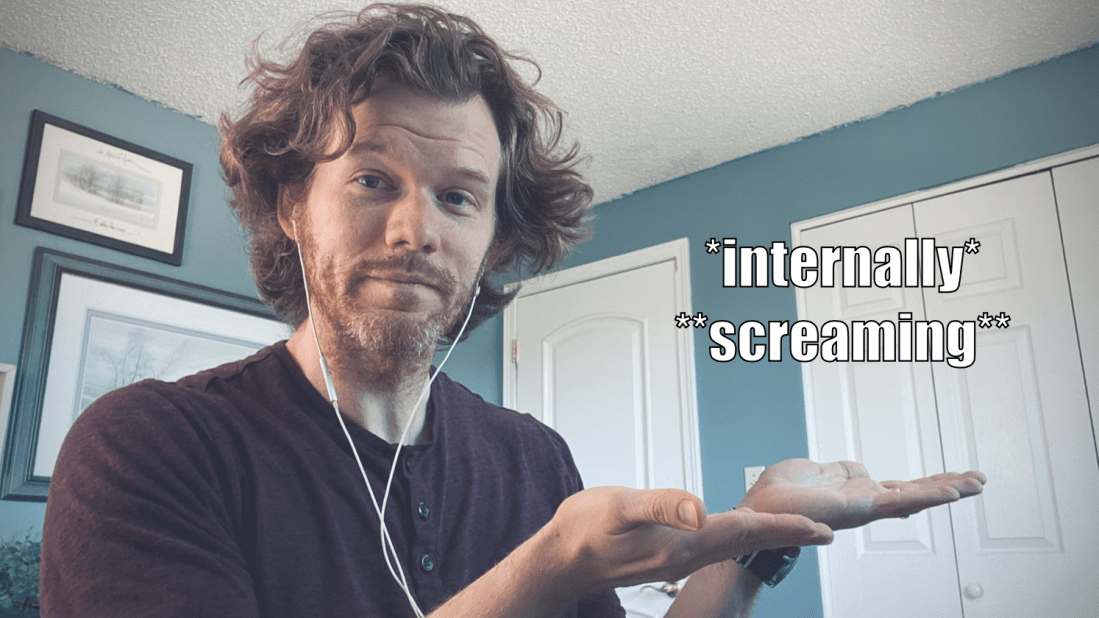
My inner monologue ran straight off the monorail and into meltdown territory. Mind you all, I’m on camera — LIVE — this entire time.

But, mirabile dictu, I managed to un-meltdown — how?

Masking for so long to “unfortunate expert” levels. My only public face is the ‘game face’ — so even at my worst, I’ve gotten so used to ‘telegraphing’ emotions by intent. Of course I felt rattled, but I’ve spent hours being rattled and looking placid or being something and looking like something else.

Practice “pre-framing” the Plan B as the Plan A. Things fall apart, and it’s hard to cope. I’ve a few posts I want to do about this, but mentally, I’ve had to practice these “backup plan” scenarios. The key challenge is thinking about that as “the plan all along” and convincing myself that this was the design.

Rent space ahead. I couldn’t dissolve my anxiety internally, but I managed to “act” my way through it — knowing that I’d be able to exhale and process this within a few minutes. I rented that time in advance to will myself along until I could bail off camera and bleed the tension out.

At the debrief, I had my joke ready:

“I’m glad I’ve grown out my hair, because I have plenty left to spare after pulling it out after my session!”

They said I recovered extremely well and that I’m “such a natural” presenter.

And that’s The Life Autistic in a nutshell: natural, unnaturally. 

Not all of the stories are successes. But I’m glad this one was. To learn more about autism from an autistic person’s perspective, follow & subscribe to The Life Autistic here and on YouTube — or follow the more whimsical, spontaneous, and amusing content on Twitter / Instagram. Thanks!
Where Empathy in Autism Runs Deepest

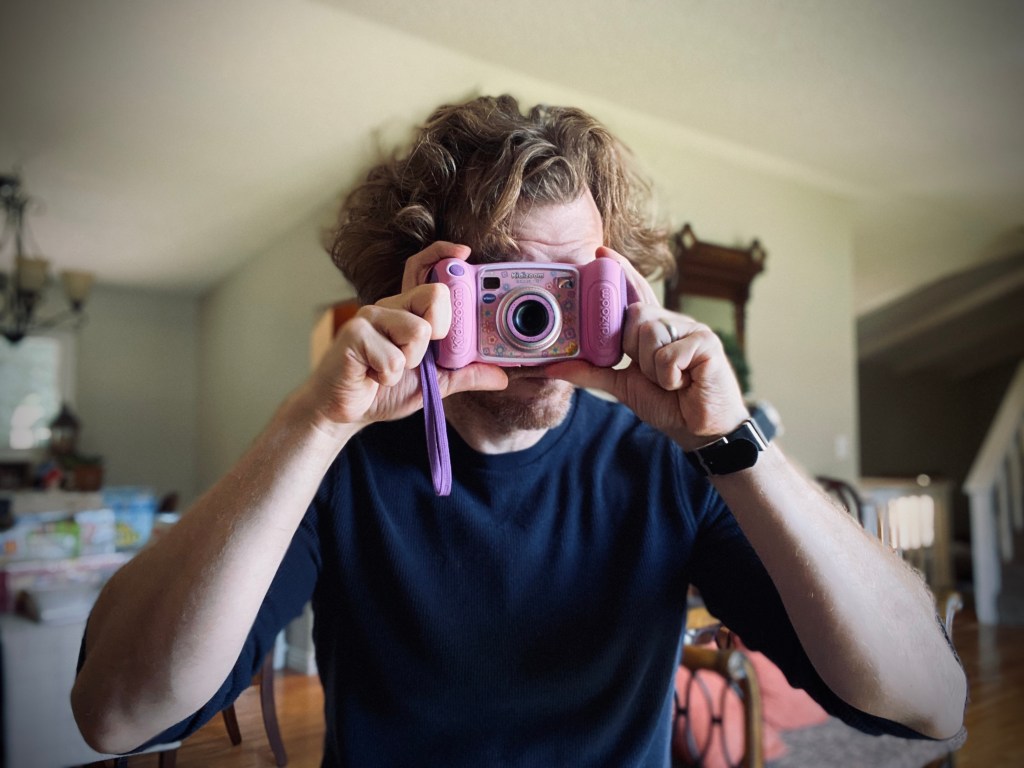
My daughter has become a bit of a budding photographer, taking a knack to staging, shooting, and recording on her little digital camera.

It’s an adorable and sweet thing to watch as she catches these candids and slices of life; with this being a non-smartphone camera, it’s more observational and less “selfie-focused” (guilty).

What gets me are the videos. She’ll narrate and create these “shaky-cam” montages that hone in on goings-on in the family, beginning with the phrase “Hi, this is me, Madeline.” Already audience-aware — and if you’re following The Life Autistic on YouTube, you’ll see what I’m talking about. 😊

But as with all things digital, she finally had “a moment.”

Inevitably, she discovered that she harnessed both the power create and destroy. After a few too many clicks and menus, she mistakenly deleted a video. It wrecked her poor little heart.

While Mrs. H2 and I assured her that she had the video backed up, Mo remained bereft of consolation.

“But it’s not on my camera anymore,” she cried. “It’s gone and I wanted to watch it on my camera.”

In the moment I was probably too autistically factual and dismissive. It’s on my computer, I thought. It’s not gone. But as I spied her curled up on the cozy chair, sobbing, my heart took a different turn.

Leaning into my “strong-but-gentle dad” mode, I picked her up, cradled all of her nearly 4-foot frame (she’s a tall five year old!), then sat back down with her.

We both cried.

I’m not often as responsively empathetic to where I can both acknowledge and feel things so intently. But I found where those converge strongest in me:

When the sadness is unique.

I’ve been sad before over deleting things. Losing things that I can’t recover. Where I won’t have them in the way I used to enjoy them. Where others looked at me and didn’t understand. Where it wasn’t “normal” to be so upset over something that small.

So in that moment, as my arms wrapped around her, her new sadness profound – I remembered my specific sadnesses of old as well. She didn’t notice the small tear or two, but we spent that 20-second moment in a specifically empathetic embrace.

We autistic folks might have our challenges with empathy. Except when it’s perhaps at its most challenging and maybe misunderstood – it then runs its very deepest.

I’ve learned that my heart responds to misunderstood sadnesses; I’m grateful to be a uniquely empathetic autistic personTo learn more about autism from an autistic person’s perspective, follow & subscribe to The Life Autistic here and on YouTube — or follow the more whimsical, spontaneous, and amusing content on Twitter / Instagram. Thanks!

Courage and Autism: Being “A Little More Brave”

IMG_5432.JPG

My oldest daughter started Kindergarten this week. She’d been excited all summer, up until the night before.

“I just want to stay home and be a baby a little bit longer,” she confessed.

I handed her the bottle I was using for Jo, the baby. She demurred. Being a baby doesn’t have the advantages she thinks it does.

But we talked about this transition, this pivotal episode.

I remembered my own first day of Kindergarten, as an undiagnosed autistic boy, whose precociousness and vocabulary would—my parents hoped—account for the myriad social struggles I faced at a young age.

The round, domed classroom had us all in quadrants, each in little collective groups of four, seated together under cold lights cascading harsh on muted colors.

I told Mo the story of how I wasn’t brave. 

The anxiety kicked in early. I was kicked out of preschool at first, so my organized schooling always began auspiciously.

I missed my parents, my routines; the alien environment began to creep into the loose-knit fabrics of my courage and unravel them.

But there was Irene.

Inconsolable.

Irene didn’t seem to be handling this well. I didn’t know her. But she was bawling, crying,   shaking. Her quaking little fear scared me. I didn’t know how to react.

It must have scared the teachers too – she was soon taken out of the class.

“I never saw Irene again,” I told Mo. “I don’t what happened to her. I wasn’t the bravest in my class, and I was just as scared, but I was just a little more brave that day.

A little more brave.

Did I know what I was back in Kindergarten? Did anyone? No.

Did I know I’d be facing some of the first of many challenges in my autistic childhood? No.

Did I ever think I’d share this story to my own future kindergartner? No.

Was I the bravest in this new little world? Hardly.

Mo did great; she’s amazing and far better at life at 5 than I was at 10. Typical neurotypical :p

I’ve come a long way myself — where even as an autistic adult, I don’t aspire to be the most courageous. Because I can’t. Or the most daring. I’d rather not.

So what’s the next best thing, to press up against the worrisome edges of anxious moments, to extend the borders of what I can feel is possible, doable?

Being a little more brave.

Courage is forged in the little things, even if they feel “big.” There’s a lot of little-big things in autism. To learn more about autism from an autistic person’s perspective, follow & subscribe to The Life Autistic here and on YouTube — or follow the more whimsical, spontaneous, and amusing content on Twitter / Instagram. Thanks!